The Illusion of a Bull Market That Has Ended
Few markets can turn enthusiasm into frustration as quickly as silver.
After a substantial advance, investors begin to anticipate sustained acceleration. Confidence grows, expectations rise, and every pullback looks like a buying opportunity. Yet when momentum fades, sentiment can change dramatically within days.
A relatively sharp correction is enough to raise the first doubts. If a prolonged consolidation follows, the perception of weakness intensifies. What initially seemed like a healthy pause begins to look like the definitive exhaustion of the trend.
But bull markets rarely unfold in an orderly fashion. And silver, by its very nature, is one of the most extreme examples of this reality.
Its history is marked by explosive advances, deep pullbacks, and long periods when the price seems unable to regain its previous momentum.
The fundamental question is not whether silver can experience significant corrections during a bull market. We know it can. The real question is how to distinguish a correction within an intact trend from a structural change in the market.
That distinction is much harder than it seems when prices are falling.
Silver Does Not Behave Like Gold
Although both metals are commonly grouped under the heading of precious metals, their behavior differs in fundamental ways.
Gold has a much more established monetary role and function as a store of value. Demand for it is influenced by central banks, expectations for real interest rates, confidence in currencies, and the search for protection against certain financial and geopolitical risks.
Silver shares some of these characteristics but also has a substantial industrial dimension.
Its use in electrical, electronic, energy-related, and other productive applications introduces additional factors that can strengthen or weaken its performance at different stages of the economic cycle.
There is also the smaller size of the silver market and a trading structure that can amplify price moves when investment flows change direction.
The result is an unusual combination: silver can behave like a monetary asset at certain times and respond like an industrial commodity at others.
This dual nature helps explain why its path is generally less stable than gold's.
During some bullish phases, gold advances relatively steadily while silver lags behind. That divergence frustrates investors who expect both metals to appreciate at the same time.
However, when conditions change and investment interest in silver increases, the recovery can be extraordinarily rapid.
Relative underperformance does not necessarily imply structural weakness. But neither does it guarantee a subsequent recovery.
Both possibilities must remain in view.
Major Trends Contain Corrections That Look Final
One of the most common mistakes is to imagine historical bull markets as relatively continuous upward paths.
Long-term charts can create that impression. When we look at appreciation accumulated over several years, intermediate pullbacks appear to be minor accidents within an obvious trend.
But that perspective changes radically when we place ourselves at the moment those pullbacks occurred.
During the great precious-metals bull market of the 1970s, silver experienced very deep corrections before reaching its highs at the end of the decade.
Something similar happened during the bull market that developed from the early 2000s through 2011.
The 2008 financial crisis triggered a collapse of more than 50% in silver from its preceding highs. At the time, it was entirely reasonable to ask whether the bull market had ended.
Yet the metal subsequently staged an extraordinary recovery and reached new highs in 2011.
This does not mean that every deep decline should be interpreted as a buying opportunity. Some anticipate prolonged bear markets, while others reflect fundamental changes in economic and financial conditions.
The historical lesson is different.
The magnitude of a correction, considered in isolation, cannot determine whether a long-term bull market has ended.
We need to examine the monetary backdrop, the evolution of demand, relative performance against other assets, and the broader market structure.
Volatility may be a feature of the cycle, not necessarily a signal of its end.
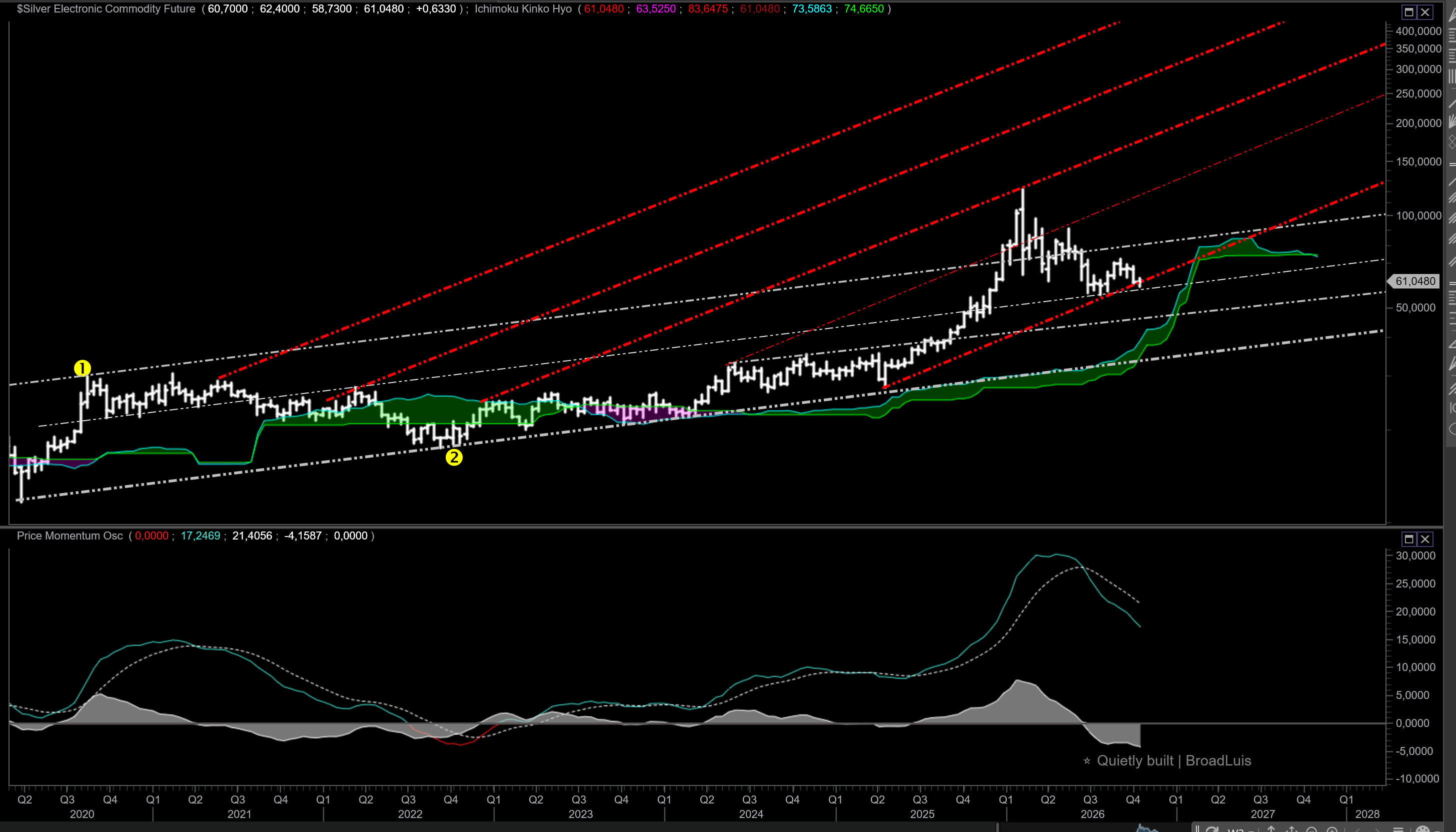
Time Corrections Can Be Just as Exhausting
When we talk about corrections, we usually think of falling prices.
Yet another form of correction can be just as frustrating for investors: the passage of time.
After a powerful advance, the market can spend weeks or months trading within a relatively narrow range.
Breakout attempts fail. Recoveries lose momentum. Every small advance raises expectations that ultimately go unfulfilled.
The price does not fall enough to offer a clearly better buying opportunity, but it does not rise enough to reward patience either.
This behavior causes considerable psychological fatigue.
Investors who bought during the euphoric phase begin to question their decisions. Others exit their positions in search of opportunities in markets showing greater momentum. Attention gradually shifts toward assets that appear to offer more immediate results.
Paradoxically, a prolonged consolidation can help moderate the excessive optimism built up during the preceding advance.
Expectations adjust, speculative activity diminishes, and the market has time to absorb the earlier rise.
From a technical perspective, a time correction also allows certain moving averages and trend references to catch up with the price without requiring a significant decline.
Still, an overly optimistic interpretation should be avoided: a sideways consolidation can also become a distribution phase ahead of a decline.
What matters is not simply that the price remains stable, but how the market's structure evolves during that period.
Time can correct the excesses of a trend without requiring price to do so violently.
And sometimes that time correction precedes moves of considerable magnitude.
The Danger of Expecting an Orderly Advance
Investors tend to feel more comfortable with bull markets that progress gradually, accompanied by moderate pullbacks and relatively predictable recoveries.
Silver rarely offers that comfort for long.
Its behavior can alternate between periods of apparent inactivity and very rapid moves. Resistance breakouts can produce significant acceleration, but also false signals that trap investors who bought expecting immediate follow-through.
This creates an additional difficulty: even when the interpretation of the cycle is correct, the journey can be far harder to endure than expected.
An investor can correctly identify a long-term bull market and still achieve disappointing results by buying after an excessive advance, using too much leverage, or abandoning a position during a correction.
The challenge is not only to anticipate the market's future direction.
The ability to manage the uncertainty between making an investment and the possible fulfillment of its thesis also matters.
In an asset as volatile as silver, expectations of immediate continuation can be particularly dangerous.
A bullish breakout does not guarantee that the price will continue rising without interruption. Likewise, a decline after a breakout does not automatically prove that the earlier move was false.
Markets need time to confirm their trends.
And that confirmation rarely arrives at precisely the moment investors would like it to.
Sentiment Can Change Before Market Structure Does
One of the most striking features of precious-metals markets is how quickly investor sentiment can change.
During acceleration phases, ambitious projections dominate, along with the conviction that any pullback will be brief.
When the market pauses, those expectations begin to moderate.
If consolidation drags on, frustration gradually replaces enthusiasm. Positive news stops producing meaningful advances, while any unfavorable development seems to justify further selling.
At times, the price ends up trading within a relatively limited range while market perceptions deteriorate much more sharply.
That divergence between sentiment and price behavior can be meaningful.
A market that absorbs unfavorable news without losing important support levels may be showing resilience that is not obvious from the headlines.
But the opposite interpretation is also possible: an inability to respond to favorable news may foreshadow weakness.
Sentiment should therefore be considered one part of the analysis, never conclusive proof.
Markets do not need optimism to return before they begin to rise. Sometimes the recovery in price comes before the change in sentiment.
What Really Matters for the Next Phase
Trying to anticipate every short-term move in silver can become a frustrating exercise.
Daily fluctuations are influenced by multiple factors: the dollar, interest rates, economic expectations, futures markets, investment flows, and liquidity needs.
All of them can cause significant moves without necessarily changing the forces that dominate the long-term cycle.
It is therefore more useful to focus on a few fundamental questions.
Are the conditions that supported the bull market still in place?
Does silver retain its ability to regain ground after corrections?
Are pullbacks progressively damaging its structure, or merely interrupting a broader advance?
Do important breakouts hold, or are they repeatedly rejected?
And, above all, are we witnessing a change in the primary trend or merely a change in its pace?
These questions do not provide infallible answers. They do, however, help prevent every price fluctuation from becoming a complete reassessment of the investment thesis.
They also preserve an essential distinction between conviction and rigidity.
Holding a long-term bullish outlook does not require ignoring signs of deterioration. A sound thesis must remain open to revision when the facts supporting it change.
Patience is a virtue only when accompanied by analysis and risk management.
A Bull Market Does Not Have to Feel Comfortable
Silver's history shows that major advances can coexist with extraordinarily difficult periods for investors.
Deep corrections, sideways movements, and false breakouts are not anomalies confined to bear markets. They can also appear within bull markets of considerable magnitude.
The real challenge is distinguishing when these moves are part of a consolidation and when they signal a structural change.
There is no formula that eliminates that uncertainty.
But there is a more useful way to approach the market: do not allow short-term volatility to replace long-term analysis, while also refusing to use bullish conviction as an excuse to ignore risk.
Silver may continue to offer significant opportunities if the conditions supporting its bull market remain intact. That does not mean its path will be easy or that every correction will resolve to the upside.
It simply means that irregular price behavior should not surprise us.
A bull market does not need to make investors comfortable. And in silver, discomfort is often part of the journey.
Structural Alpha Research | Market Perspectives
This article presents a general interpretation of precious-metals market behavior. It is not investment advice or a prediction of silver's future price.