The Paradox of Strong Gold and Weak Miners
There is a seemingly logical expectation among precious-metals investors: if the price of gold rises, shares in the companies that produce it should rise even more.
After all, a mining company sells gold, and when its price increases, so does its potential revenue. If costs remain relatively stable, a significant portion of that improvement should translate into profits.
Yet markets rarely behave so simply.
Across different cycles, gold has recorded major advances without mining shares immediately following suit. At times, those stocks have continued to lose value even as the metal reached new highs.
This divergence often causes confusion. If the product these companies sell is becoming more valuable, why are investors unwilling to pay more for the businesses?
The answer is that gold and the companies that produce it are different assets, subject to forces that do not always move in the same direction.
Understanding those differences helps explain why the metal can lead the miners—and why that sequence is not, by itself, an anomaly.
Gold Is Not a Mining Stock
Gold is both a monetary asset and a commodity. Its price responds to factors such as real interest rates, inflation expectations, confidence in currencies, central-bank purchases, and perceptions of financial or geopolitical risk.
A mining company, by contrast, is a business.
It has employees, facilities, machinery, financial obligations, capital expenditure requirements, and operational risks. Its results depend on both the price of gold and its ability to extract that gold profitably.
This distinction becomes particularly important during periods of economic uncertainty.
Gold can attract capital precisely because investors are seeking protection from certain risks. But those same risks can lead investors to reduce their exposure to equities, including mining stocks.
Under those conditions, the metal can benefit from defensive demand while miners suffer the consequences of broader risk aversion.
Gold's role as a safe haven does not automatically make mining stocks defensive assets.
That difference can explain a substantial part of their relative performance.
Gold Prices Rise—but Costs Can Rise Too
Operating leverage is one of the main attractions of gold producers.
If a mine sells gold at a higher price while keeping costs under control, the increase in its margins can be proportionally greater than the metal's advance.
But that mechanism also works in reverse.
Mining is an energy-, equipment-, materials-, transportation-, and labor-intensive business. Maintaining stable production also requires continuous investment.
During inflationary periods, a rising gold price can coincide with substantial increases in extraction costs.
As a result, higher revenue does not always translate into a comparable expansion in margins.
Even when profits improve, investors may remain cautious if they believe that improvement will not last.
All-in sustaining costs, capital requirements, and free cash flow generation may matter more to a company's valuation than the gold price alone.
That is why a bull market in gold does not automatically guarantee a bull market in mining profits.
And without a convincing improvement in corporate profitability, share prices can continue to lag.
The Stock Market Looks Ahead
Stocks do not reflect only a company's current results. They incorporate expectations about future earnings, risks, and the return investors demand for holding them.
That adds another dimension.
A mining company can report growing profits and still see its share price stagnate if the market has already priced in that improvement.
The opposite can also happen.
A company whose results have not yet changed significantly can begin to appreciate when investors anticipate future margin expansion.
The relationship between gold prices and mining stocks therefore does not have to be simultaneous.
Sometimes the metal leads for an extended period before investors fully recognize the effect of higher prices on the sector's profitability.
At other times, miners move ahead of gold because the market anticipates a favorable change.
Share prices respond not only to what is happening, but also to what investors believe will happen.
The divergence between the two assets may partly reflect a divergence in their respective expectations.
The Weight of Accumulated Distrust
Markets have memories.
Gold mining companies have gone through periods when high metal prices failed to produce satisfactory value creation for shareholders.
Expensive acquisitions, project cost overruns, equity dilution, debt, and undisciplined investment decisions have historically damaged confidence in parts of the industry.
That experience can shape investor behavior even when conditions begin to improve.
A rising gold price is not enough.
The market also wants evidence that companies can turn higher prices into earnings, cash flow, and sustainable returns for shareholders.
Until that confidence returns, valuations can remain depressed.
But there is another side to this phenomenon.
When sentiment toward a sector is persistently negative, a verifiable improvement in results can trigger a meaningful reassessment of expectations.
Not because shares are obligated to recover their lost ground, but because the market may begin to value earnings differently once it considers them more dependable.
The recovery of confidence can then become as important as the performance of gold itself.
Miners Compete for Capital With the Entire Market
Another common mistake is to analyze mining stocks only in relation to gold.
In reality, listed mining companies compete for investors' capital with thousands of businesses across other sectors.
When certain areas of the market offer strong earnings growth, greater visibility, or more favorable price trends, they can absorb a substantial share of investment flows.
Mining stocks may look attractively valued and still remain overlooked for a long time.
Not necessarily because their prospects are poor, but because investors see more compelling alternatives.
This matters especially in markets dominated by a small number of sectors or large companies.
The concentration of capital can prolong divergences far beyond what conventional valuation comparisons might suggest.
Gold can continue appreciating while mining shares remain low on the priority list of major investors.
But capital flows are not permanent.
When market leadership changes, sectors that had been forgotten can begin attracting attention relatively quickly.
The problem is that a low valuation or a prolonged divergence cannot tell us when that rotation will occur.
Patience may be necessary, but it is no substitute for market confirmation.
A Lag Can Turn Into Acceleration
One of the most interesting characteristics of mining cycles is that relative weakness can persist for a long time before giving way to powerful moves.
The explanation lies in the combination of several factors.
If gold remains at elevated levels, companies' revenues can continue benefiting from those prices.
If costs stabilize at the same time, margins may begin improving more visibly.
And if that improvement coincides with a shift in investor expectations, share prices can benefit from two positive forces: higher expected earnings and a more favorable valuation of those earnings.
The result can be a period of outperformance relative to the metal itself.
This mechanism helps explain why miners have historically shown considerable capacity to accelerate during certain phases of gold bull markets.
However, a mechanical interpretation should be avoided.
Accumulated underperformance does not guarantee a subsequent recovery.
Some companies may continue struggling because of company-specific problems, deteriorating assets, financial difficulties, or unfavorable management decisions.
And an entire sector can remain behind if broader market conditions do not encourage capital inflows.
The potential for recovery exists, but it requires conditions that allow it to materialize.
Is the Miners' Long Underperformance Against Gold Coming to an End?
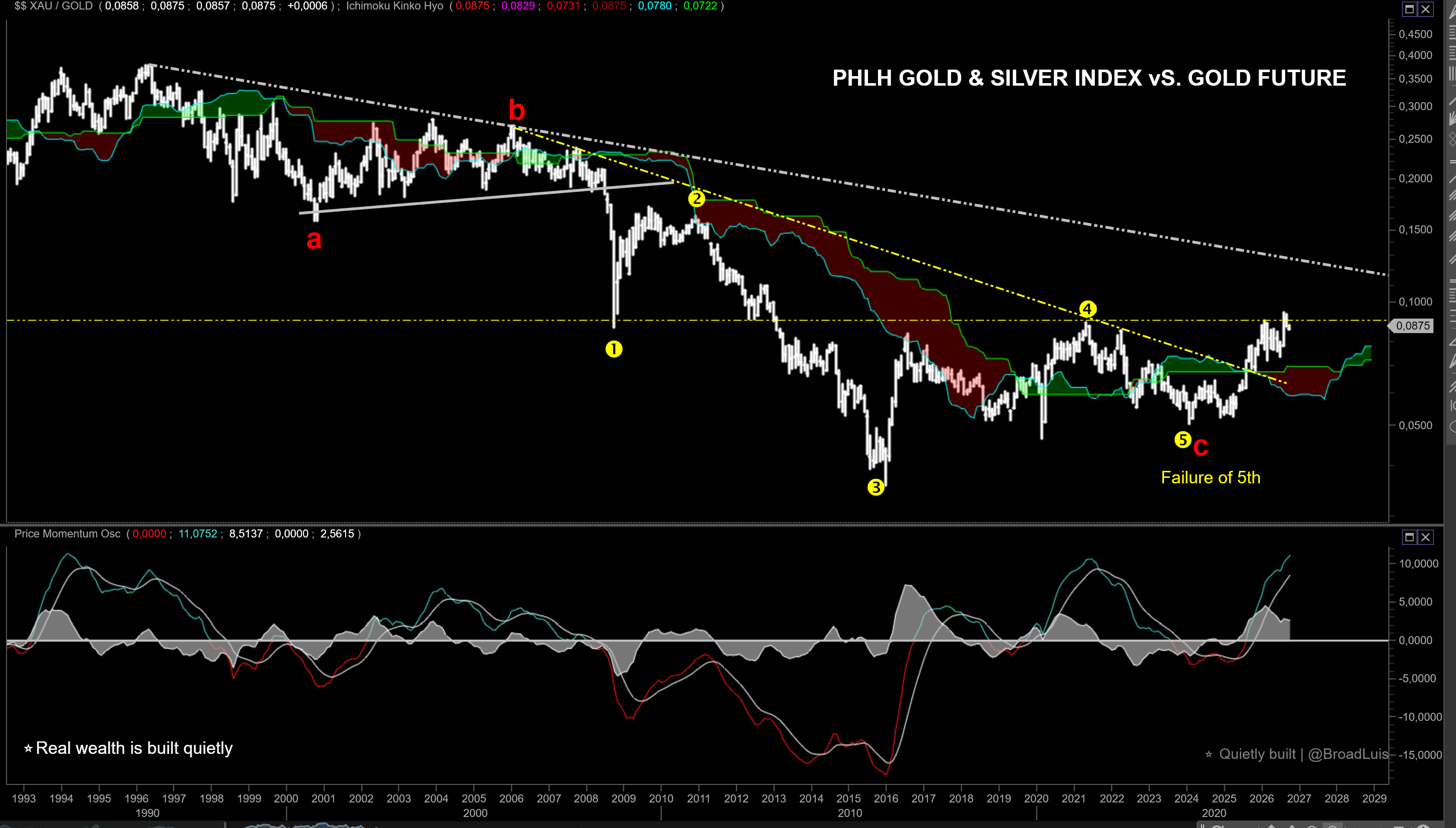
The historical performance of the PHLX Gold & Silver Sector Index ($XAU) relative to gold provides a particularly revealing perspective.
For almost three decades, mining companies have experienced an extraordinary deterioration in relative strength. The ratio shows a sequence of declining highs that illustrates just how extensively gold has outperformed the shares of companies linked to its production.
This divergence is one of the clearest demonstrations that a gold bull market does not necessarily guarantee favorable performance from mining stocks.
Yet the more recent technical structure raises an interesting question.
The long-term decline may have developed a five-wave sequence, with the possibility that its final leg ended in a failed fifth wave.
This interpretation should be treated as a technical hypothesis, not definitive confirmation. Nevertheless, it would be consistent with a gradual exhaustion of the relative downtrend.
At the same time, the ratio has begun showing signs of recovery.
A break above an intermediate descending trendline, an improving position relative to the Ichimoku cloud, and accelerating momentum suggest that the relationship between miners and gold may be changing.
However, there is a fundamental difference between a relative recovery and a structural reversal.
The major descending trendline that has dominated the chart since the 1990s remains an important resistance level. A sustained break above it would provide much more convincing evidence that the prolonged period of relative weakness is coming to an end.
The question is no longer simply why miners have lagged gold, but whether we are beginning to see the conditions necessary for that relationship to change.
There is no guarantee that such a change will occur. But after so many years of relative deterioration, signs of a possible transition deserve close attention.
Not All Miners Respond the Same Way
Treating gold miners as a homogeneous group can also lead to misleading conclusions.
Large producers, mid-tier companies, and small exploration businesses have very different risk profiles.
A major producer operating several mines may benefit directly from a higher gold price, although it remains exposed to costs, capital requirements, and operational risks.
A development-stage company may depend more heavily on available financing, permits, and the economic viability of its projects.
An exploration company may have an even more indirect relationship with the current metal price. Its valuation may depend primarily on discoveries, drilling results, potential resources, and its ability to finance operations.
As a result, during the same market phase, some companies can show extraordinary strength while others remain deeply depressed.
Higher gold prices improve the general backdrop, but they do not erase differences in business models, balance sheets, asset quality, and management teams.
Nor do they guarantee that capital will flow evenly into every segment of the industry.
Sometimes a recovery starts with large producers and later spreads to smaller companies.
At other times, certain small stocks lead for specific reasons that have little to do with the broader sector.
There is no universal sequence.
The breadth of participation and relative strength across different segments can provide valuable information about how the cycle is evolving.
What Should We Watch for Signs of Change?
When gold is strong and miners remain behind, it is tempting to conclude that they must eventually make up all the lost ground.
But markets are under no obligation to do so.
A divergence can close through rising mining shares, a correction in gold, or a combination of both.
It is therefore more useful to look for evidence of a genuine change in the sector's behavior.
The performance of miners relative to gold is a first reference point.
If their shares begin consistently outperforming the metal, investor expectations may be shifting.
The breadth of the recovery also matters.
An advance concentrated in a handful of companies has different implications from one in which a growing share of the sector participates.
Volume, medium- and long-term trends, and the relative performance of different segments can help assess the strength of that move.
And, of course, it is essential to determine whether corporate results support those expectations.
Improving margins, cash generation, and financial discipline can provide a foundation for a more durable revaluation.
None of these factors offers certainty on its own.
But their convergence can be more convincing than simply observing that mining stocks look cheap relative to gold.
Gold's Leadership May Be Only the First Part of the Story
Mining companies' underperformance relative to gold is not necessarily a contradiction.
It can reflect cost pressures, earnings uncertainty, accumulated distrust, risks inherent in equities, or capital flows favoring other sectors.
Yet these circumstances do not have to be permanent.
If the environment for gold remains favorable, companies manage to convert higher prices into stronger margins and cash generation, and investors begin to recognize that improvement, mining stocks could experience a significant relative recovery.
The historical chart of the $XAU-to-gold ratio reminds us just how long such a recovery has been awaited.
It also shows why it would be premature to declare a multidecade structural reversal confirmed.
Perhaps gold has led the first part of this bull market. The truly interesting question is whether mining stocks are preparing to play a much more important role in the next.
Structural Alpha Research | Market Perspectives
This article presents a general interpretation of precious-metals markets and mining stocks. It is not investment advice or a prediction of future share prices.